Welcome to the PlayACCESS Initiative!

PlayACCESS by Corso SMART Lab: Where Learning, Design, and Play Connect
PlayACCESS by Corso SMART Lab promotes inclusive, accessible play for individuals of all ages and abilities. Through toy adaptations, switch-access technology, and hands-on student training, we teach future speech-language pathologists how to modify commercially available toys and equipment to create accessible play experiences that support participation, communication, and independence.
Support PlayACCESS™ through our current donation wish lists. Choose from toys & equipment to adapt, access innovation & testing, tools & build supplies, or PlayACCESS™ program needs. Every donation helps students explore, build, test & expand access.
3rd Annual PlayACCESS™ Adaptive Equipment Drive

3RD ANNUAL PLAYACCESS™ ADAPTIVE EQUIPMENT DRIVE
October 1–December 2, 2026
PlayACCESS™ by Corso SMART Lab, in partnership with the Saint Mary’s NSSLHA Chapter, is collecting new and gently used battery-operated toys and equipment to support accessible play, participation, and communication.
Donations are directed to the Corso SMART Lab for PlayACCESS™ activities.
Questions About Donated Adapted Equipment

PlayACCESS™ by Corso SMART Lab provides adapted equipment and adaptive switches to support accessible play and participation.
If your donated equipment or adaptive switch stops working properly, or if you notice any wear, damage, loose parts, exposed wiring, or concerns with the modification, please stop using the equipment immediately and contact the Corso SMART Lab for next steps. This aligns with the equipment release guidance provided to both families and organizations.
Contact Us
For questions, concerns, or support related to donated PlayACCESS™ equipment, please email:
When emailing, please include:
- Your name
- Organization or family name
- Donated equipment item
- A brief description of the issue
- Photos or videos of the concern, if available
Important Safety Reminder
All donated adapted equipment and adaptive switches are provided “as is” with no warranty or guarantee of quality, functionality, or suitability for a specific purpose. Safe and effective use of the equipment is the responsibility of the user, family, or organization.
PlayACCESS™ is a trademark of Corso SMART Lab.
🏈 PlayACCESS™ Beyond Play: Accessible Sports & Fandom

Expanding Access from Play to Participation
Play is not the only meaningful activity that can become inaccessible.
Through graduate AAC education, undergraduate research, and the Corso SMART Lab, we are exploring how communication and physical access influence participation in sports, recreation, play, and fandom.
In Fall 2026, 29 graduate speech-language pathology students are using Ms. Crippen’s NFeLementary™ curriculum as a foundation for examining NFL-related communication and participation through an AAC & accessibility lens. Students serve as AAC Access Coaches for simulated clients, identifying vocabulary and messages, communication supports, physical access strategies, environmental adaptations, and assistive technology features that may support authentic participation.
Additionally, 6 undergraduate Research Practicum students are contributing through the Corso SMART Lab and PlayACCESS™, exploring adaptive play, physical and communication access, and how NFL-themed toys and experiences might be adapted for individuals with different motor and communication needs.
Through related NFLife activities, we are beginning to consider how these principles might extend beyond elementary-aged learners and support meaningful participation across the lifespan.
Questions we are exploring include: How does someone who uses AAC participate in game-day conversations? What vocabulary and messages matter to an individual fan? Can NFL-themed toys and activities be adapted for alternative access? How might physical access affect collecting, playing, watching, or celebrating? How can we increase access without changing the authenticity of the experience?
This work reflects a central principle of PlayACCESS™: access is not simply being able to use an object—it is being able to participate in experiences that matter.
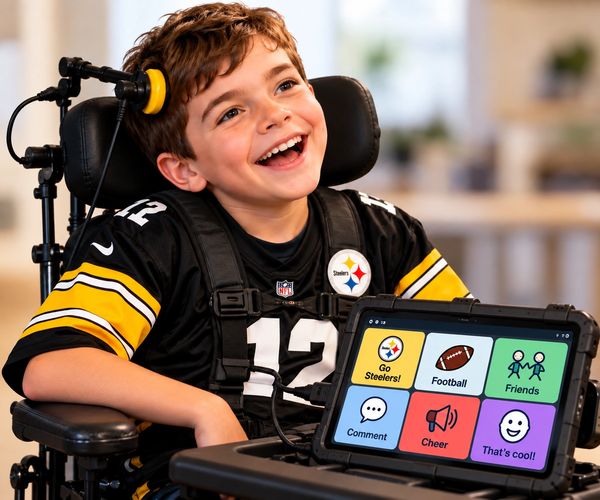
Meet Brady
Our Class Model
Brady serves as General Manager for the Pittsburgh Steelers in our semester-long AAC simulation.
He helps us think about how to support meaningful participation in the activities, conversations, and fandoms that matter to him. Through Brady, we explore how communication and physical access influence participation in NFL-related experiences.
Brady uses a speech-generating device (SGD) with symbols and text to communicate and accesses his device using a switch positioned near his head. He enjoys talking about the Steelers, watching games, sharing highlights with others, and being part of game-day traditions.
In our work with Brady, we consider his individual strengths, interests, communication needs, and access needs while identifying vocabulary, messages, access strategies, and assistive technology features that may support authentic participation.
Brady reminds us that access is about more than using a device—it is about participating in the activities, conversations, communities, and fandoms that make life meaningful.

PlayACCESS Build Day 2026: Innovation, Inclusion, and Impact in Action
On April 11, 2026, the Corso SMART Lab hosted the 2nd Annual PlayACCESS Donation & Adaptation Build Day. Bringing together students, faculty, and community partners for a day centered on innovation, collaboration, and service. With generous donations from the Saint Mary’s community and support from Thrivent Action Teams, this year’s event exceeded expectations, allowing us to expand both the quantity and quality of adaptive equipment created.
Students across undergraduate and graduate levels worked side-by-side in a hands-on learning environment, designing and modifying toys and devices to increase accessibility for individuals with physical and communication needs. Through this collaborative effort, participants not only developed technical skills in assistive technology but deepened their understanding of inclusive design and community impact.
This event reflects the heart of PlayACCESS — where education meets service, and innovation creates meaningful opportunities for independence, participation, and play.

2026 Build Day Donation Drive
We are now accepting donations through April 6, 2026 for our PlayACCESS Adaptation Build Day on April 11, 2026!
The Corso SMART Lab in partnership with Saint Mary’s College National Student Speech Language Hearing Association (NSSLHA) is hosting an Adaptive Equipment Donation Drive to support hands-on learning in accessible and inclusive play.
Through PlayACCESS, students will use donated toys and equipment to design and create permanent, adapted solutions that promote meaningful access to play for individuals of all ages and abilities. These adapted builds will support classrooms, clinics, and community partners throughout the South Bend area.
Items on our Amazon Wishlist include:
Electronic card shufflers
Toy baseball pitching machines
Interactive singing plush toys
Cause-and-effect toys
Build materials
And more adaptive-friendly play materials
Every donation helps transform everyday toys into universally accessible experiences.
Thank you for supporting accessible play, communication access, and inclusive design through PlayACCESS!
PlayACCESS Adaptive Equipment Build Day – April 11, 2026
The Corso SMART Lab and the Saint Mary’s College National Student Speech Language Hearing Association (NSSLHA) invite students and faculty from Saint Mary’s College and the University of Notre Dame to join us for the PlayACCESS Adaptive Equipment Build Day on April 11, 2026, in the SPARK Lab on the Saint Mary’s College campus.
During this hands-on event, participants will work together to modify toys and electronic devices so individuals with physical or complex communication needs can independently access and participate in play.
Through the PlayACCESS initiative, the Corso SMART Lab promotes inclusive design, assistive technology innovation, and meaningful access to play, participation, and communication for individuals of all ages and abilities.
2026 Community Partners Selected for PlayACCESS Adaptive Equipment Build Day
We are excited to announce our 2026 PlayACCESS Community Partners, who will receive the adapted equipment created during this event:
- First English Lutheran Preschool
- A Rosie Place for Children
- Reins of Life
- Early Childhood Development Center (Saint Mary’s College and University of Notre Dame campuses)
- Judd Leighton Speech and Language Clinic
We can't wait to start building for you in April!

The Inaugural Launch of PlayACCESS
In Spring 2025, the Corso SMART Lab launched the inaugural PlayACCESS initiative in partnership with the Saint Mary’s College NSSLHA chapter and the Saint Mary’s College Spark Lab. Students collected donated toys and worked in the Saint Mary’s College Spark Lab maker space to adapt toys for switch access, creating inclusive play opportunities for individuals with physical and communication needs (April 26, 2025). The adapted toys were donated to A Rosie Place in South Bend, Indiana, marking the beginning of the PlayACCESS program’s commitment to accessible play and community partnership (May 8, 2025).
The Inspiration Behind PlayACCESS

The Inspiration Behind PlayACCESS
This work is deeply personal to me. Before returning to Ohio University to complete my PhD, I spent much of my clinical career as a speech-language pathologist working with individuals with severe disabilities who relied on augmentative and alternative communication (AAC).
During my doctoral program, I had the opportunity to work with Dr. Diana Schwerha in the College of Engineering and Technology. Through her mentorship, I pursued a minor in Human Factors and collaborated with students in Industrial and Systems Engineering courses to bring disability perspectives into engineering design.
One experience that left a lasting impression on me was Dr. Schwerha’s Adapted Electric Cars for Children with Disabilities class project. I had the opportunity to accompany her and her students into the community to witness the real-world impact of engineering solutions designed with accessibility in mind. That experience reinforced something I had observed throughout my clinical career—the profound difference adapted equipment can make in participation, independence, and communication.
When I joined the faculty at Saint Mary’s College, I knew I wanted to create a similar hands-on learning opportunity for our students. Through PlayACCESS, we teach future speech-language pathologists how to modify commercially available toys and equipment so individuals of all ages and abilities can independently access play, participation, and communication.